We Are Economically Excluded. Will AI Make Us Future-Excluded Too?
Also, Elon Musk, Blackstone, and Mayor Mamdani.

Art Industry Insights With Reena Devi’s Official Unofficial Email Dispatch
If you are receiving this unfiltered, unfancy email, you are a supporter, subscriber, or collaborator of Art Industry Insights With Reena Devi, or someone whom I consider a future supporter, subscriber, or collaborator.
I think this is what they call manifesting.
Art Industry Insights With Reena Devi is an independent media founded by author, journalist, and editor Reena Devi, exploring arts and culture through data stories and real world insights.
Tips, leads, and commissions are more than welcome.
This work is really not possible without your support. Even a one-time contribution goes a long way.
Where Is Our Place In The Future Being Shaped Today?

In November 2025, I wrote about a growing labour crisis amongst aspiring art capitals across the Gulf and Asia, fuelled by a systemic culture of hyper-competitiveness, cronyism, discrimination, and antipathy.
I also wrote about established art capitals in the west - particularly their consistent “erasure of creative labour” and employee burnout.
Now, due to wars, economic crisis, and a shrinking global art industry, the pre-existing fissures of established and aspiring art capitals make it near impossible for those of us working in arts and culture to thrive, let alone persist.
Over the last six months, every single conversation I have had in the art world, involved someone laid off, compelled to leave the industry, or working with thinly stretched resources. This is happening across art scenes in New York, London, Doha, Hong Kong, and more.
Under such harsh economic conditions, will the accelerated implementation of AI guarantee our exclusion from the future being carved out by tech titans and governments around the world today?
We Are All Input Generators Now
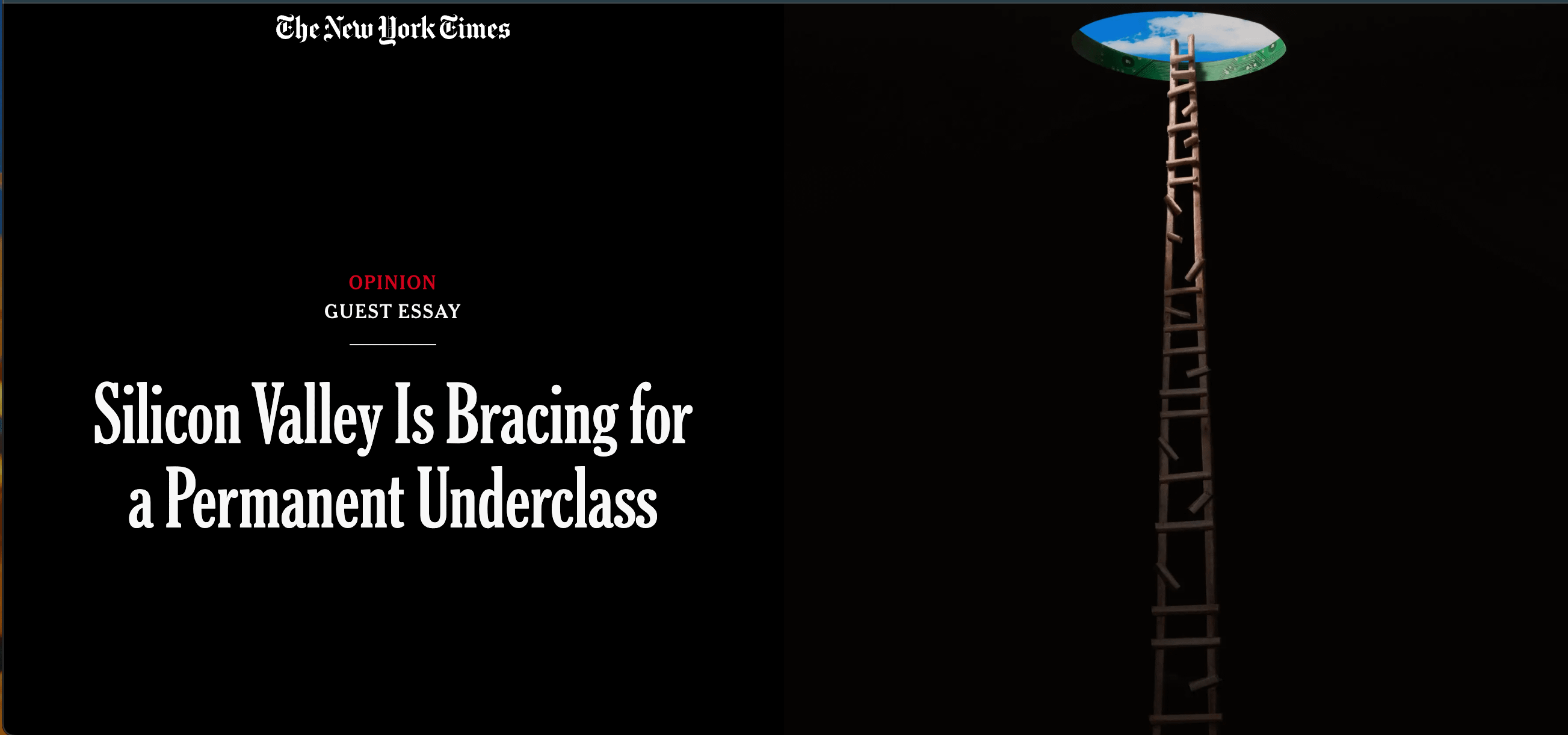
The latest Gen Z uproar against AI and Silicon Valley’s current obsession with the rise of a “permanent underclass” make this technology the big bad monster of our time. Understandably so.
Presently, Getty Images is following a gathering tide of media conglomerates and publishing houses, such as News Corp, Harper Collins, and Guardian Media Group, considering themselves generators of “AI input”, and signing lucrative deals with tech conglomerates.
In an open letter opposing these deals, US booksellers and publishing sector stated: “We recognize this effort for what it truly represents: A project to improve the capabilities of computers tasked with mimicking the work of real artists, with the goal of producing commercially-viable products without real human artistry involved at all.”
However, AI in itself is not the kryptonite - it is merely the latest technological manifestation of a historically unprecedented concentration of power and wealth amongst specific individuals.
The Myth Of ‘The Great Man’ Behind The Robot

The tech oligarchy and private wealth pushing AI essentially view it as a chance for productivity without the tax of labour. This is unsurprising since tech titans like Elon Musk seem to lack any inclination to look after the worker or secure workers’ consent.
Why else would Tesla’s Gigafactory in Grünheide, Germany, remain the only major automotive factory in the country operating without a traditional collective bargaining agreement?
So why are the agendas of technologists and technocrats controlling the inner wiring of this world so delineated from the welfare of people?
Gad Saad, a Canadian marketing professor, argues in his new book, ‘Suicidal Empathy: Dying To Be Kind’: “A society dies when it cares more about exhibiting infinite tolerance and empathy than invoking its survival instinct.”
Alarmingly, his ideas have resonated deeply with prominent billionaires like Musk, who said suicidal empathy will “end civilization.” Their business decisions certainly mirror these beliefs.
Historically, the stock market was seen as a means of negotiating social consent. Currently, corporate governance has been restructured to allow companies like Facebook and Space X to go public, while the CEO or founder still retains most control of its shares and votes, according to Quinn Slobodian, co-author of ‘Muskism’.
It also explains why tech leaders pushing AI, as well as a majority of their corporate and government partners, have seemingly little care that the AI bubble will likely exacerbate an already worsening affordability crisis and economic crisis.
A Global Octopus: The Money Behind AI

Take Blackstone for example - a US-based private equity firm, that describes itself as the world’s largest alternative asset manager.
The Financial Times reported in January 2025 that co-founder of Blackstone, Stephen Schwarzman, had been disrupting the London art market by paying record prices to acquire paintings by leading 18th century society portrait artists.
For one, Thomas Gainsborough’s portrait “Lady Bate-Dudley” (1787) had been on long-term loan to London’s Tate Gallery. It was withdrawn from the Tate collection in 2024 after the owner sold it privately through Simon Dickinson, a London gallery.
So how is Schwarzman’s Blackstone making its money?
To begin with, it is one of the largest real estate firms owning rent stabilised apartments in New York City.
While rent stabilised apartments are intended to house those who cannot afford market prices, the last few years saw a 12.6% cumulative stabilised rent increase during former New York mayor Eric Adams’ term, benefitting the private equity firms owning such real estate portfolios.
Hence, one of the rallying cries of current mayor Zohran Mamdani’s winning election campaign was freezing rent.
Additionally, this summer saw Blackstone raise $13.1 billion for its biggest Asia private equity fund, exceeding its initial target, buoyed by high-net-worth investors wanting to diversify from the US, partly due to geopolitical uncertainty.
Blackstone also saw its biggest gains thanks to its investment in AI giant Anthropic. Their profits look set to grow, given the recent lifting of government restrictions on Anthropic’s latest versions of its Claude chatbot and its most powerful model, Mythos 5.
Blackstone is a clear example of the transnational nature of private wealth and its myriad impact on our interconnected, technologically accelerating world today. Specifically, spotlighting the symbiotic relationship between extreme wealth and unregulated markets, from AI to art.
Counterargument: What If We Are Actually The Beating Heart?

This July, New York mayor Mamdani and the City Council announced that they will provide $323.8 million to the New York City Department of Cultural Affairs (DCLA), which administers public funding to arts institutions throughout the city.
It is the highest-ever yearly appropriation, with a nearly 7% increase from last year’s then-record $299.6 million investment. The overall city budget also includes a ‘Cultural Stability Fund’ for struggling arts organisations.
In a statement to Hyperallergic, Mamdani referred to the city’s artists and cultural institutions as New York’s “beating heart.”
Over six months since he took office, Mamdani has delivered for the working population of one of the most expensive cities in the world, the very things most of us have been told are impossible in these fiscally fraught times - from free childcare to rent freeze to even paving 165,000 portholes in roads.
Mamdani isn’t just creating a whole new benchmark for what we can expect from our political leaders and governments worldwide.
He is showing all of us, including those of us who create art or labour within systems supporting the creation of art, our own lack of faith and imagination in envisioning and enacting a better society to live and thrive within.
Instead, we have adhered with lover-like devotion to the maxim of “sacrifice and settle”, as advocated by a pervasive systemic culture fostered by those with power and wealth.
ICYMI: Talking The Talk
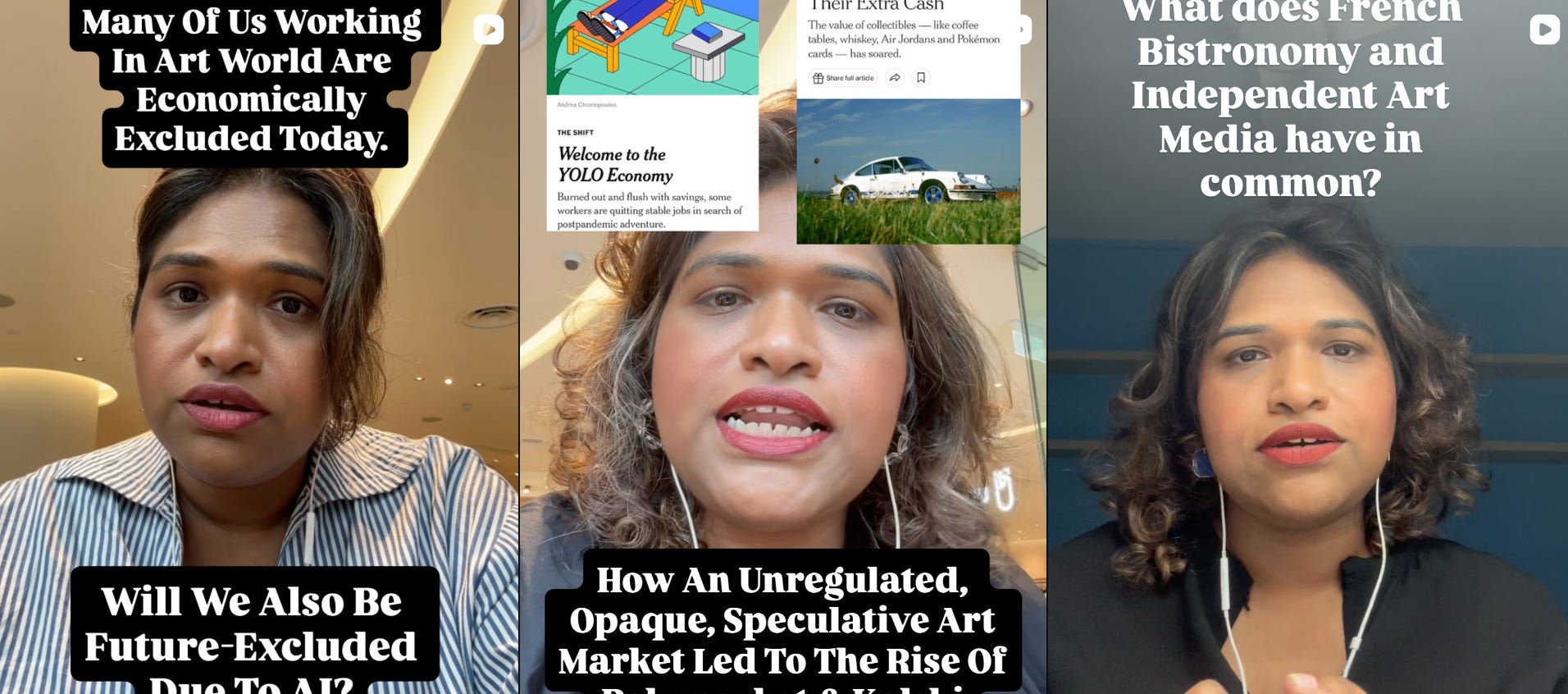
I have been putting my face and voice out into the world this summer - discussing my latest research on betting platforms, independent art media, French bistronomy, and of course, AI, in a slew of Instagram Reels that predictably have been getting more views than most of my articles this year.
To follow my (possibly deluded) rise as a news influencer, you will need to follow Art Industry Insights With Reena Devi on Instagram. My upcoming video promises to discuss the least sexy topic in the art world.
Walking The Walk: An Open Call To The Future
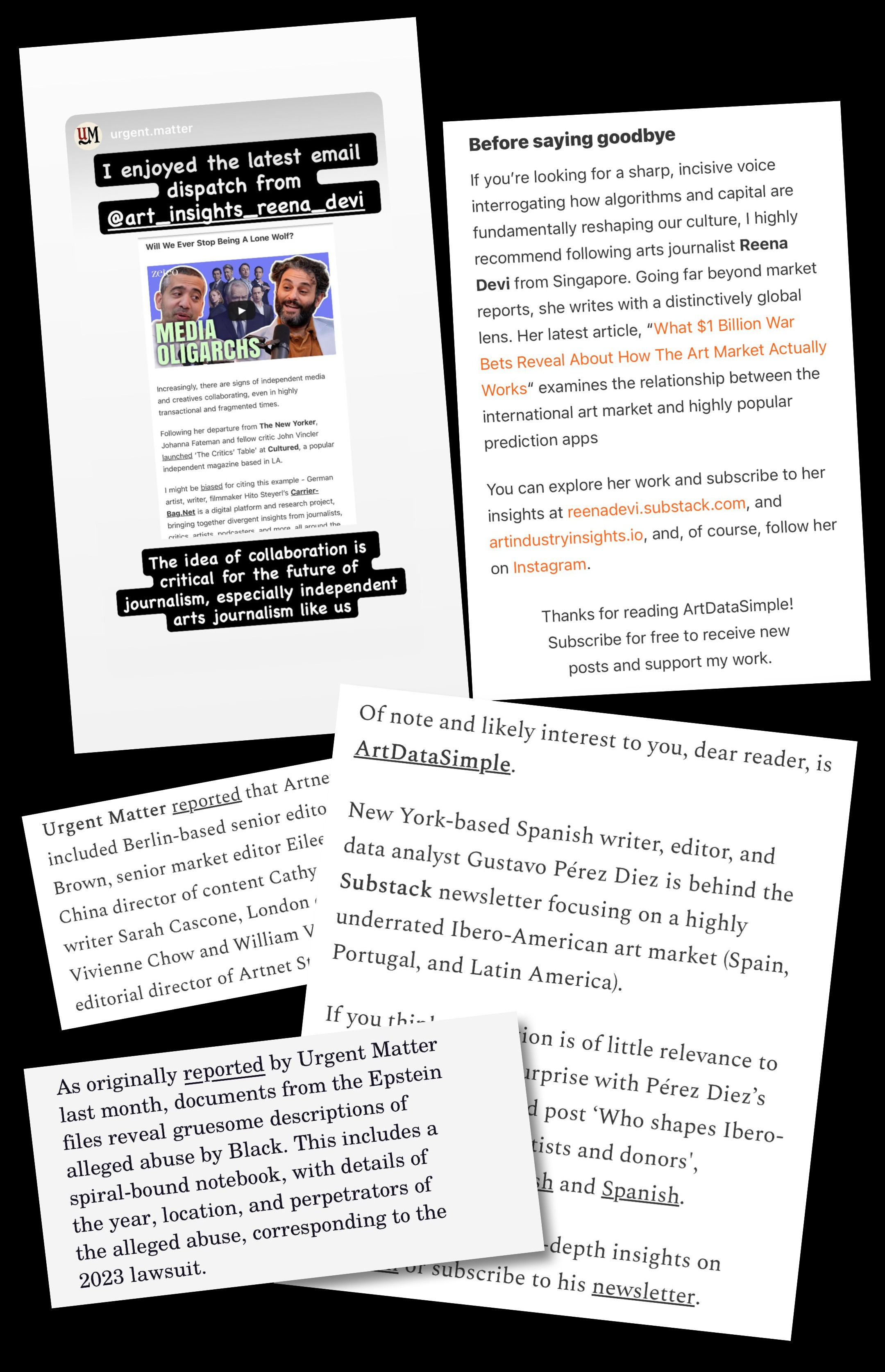
Speaking of relentless, fact-finding, globally aware independent art media, I have been collaborating with a few like-minded media in ways that do not tap on our already stretched resources. We have been sharing and citing one another’s genuinely resonant work.
I sincerely hope this is only the beginning. I hope these collaborations deepen with more independent art media across the world.
Mainly because independent media, especially in the arts, need to break away from the culture of hyper-competition and antagonism that has shaped traditional media for so long. Doing so allows us to better serve readers with the facts and transparency they need, while sustaining ourselves as essential members of the ecosystem.
Any independent media who want to get in touch and collaborate, please reply to this newsletter, DM Art Industry Insights on Instagram or reach out to Urgent Matter at adam@urgentmatter.press.
To everyone else, please support independent art media - subscribe, share, follow or contribute through relevant links. We cannot do this without you.